What Are the Key Considerations for Trenchless Reaming Operations?
What Are the Most Important Things to Think About When Doing Trenchless Reaming?
Trenchless technology is an important part of installing pipelines and other infrastructure in cities. The reaming phase of Horizontal Directional Drilling (HDD) is especially important for making sure that the pipeline can be laid smoothly.

If you don’t use the equipment properly, it can not only slow down the project, but it can also cause serious accidents like drills getting stuck or equipment getting buried. Today, we’ll talk about five important things to remember when reaming to help you avoid common mistakes and make sure your project is a success.
Find the Final Reaming Diameter: Size Doesn’t Matter
You might think that a bigger reamed hole is always better, but that’s not true.
The largest reamer diameter D should be between 1.2 and 1.5 times the diameter of the pipe that needs to be installed.
The reamed diameter should be between 600mm and 750mm if you are putting in a 500mm pipe, for instance.
Why should you not do too much reaming?
A hole that is too big can cause a lot of damage to the ground, even making it sink.
It also makes drilling fluid use go up and pull-back resistance go down, which makes equipment heavier and costs more.
So, the first step to building something well is to do a scientific calculation based on the size of the pipes.
Choose the Right Reamer for the Ground Conditions
There are different kinds of reamers, like tapered, barrel, and wing-style, but none of them work well in all types of ground.
If the soil is soft or clay, use wing-style reamers that can cut well.
If you have sandy or gravel layers, choose reamers with rolling teeth and stabilizer wings to keep them from getting stuck.
Rock formations: To break rocks quickly, use roller cone or diamond reamers.
It’s like trying to cut a steak with a butter knife: using the wrong reamer is a waste of time and likely to fail.
Take charge of the reaming step: make sure it goes slowly.
The reaming step is the gradual widening of the hole with each pass. When you try to get the final diameter all at once, it often leads to:
Not enough torque, which can cause equipment to stop working or break down.
Borehole walls that aren’t stable, which raises the risk of collapse.
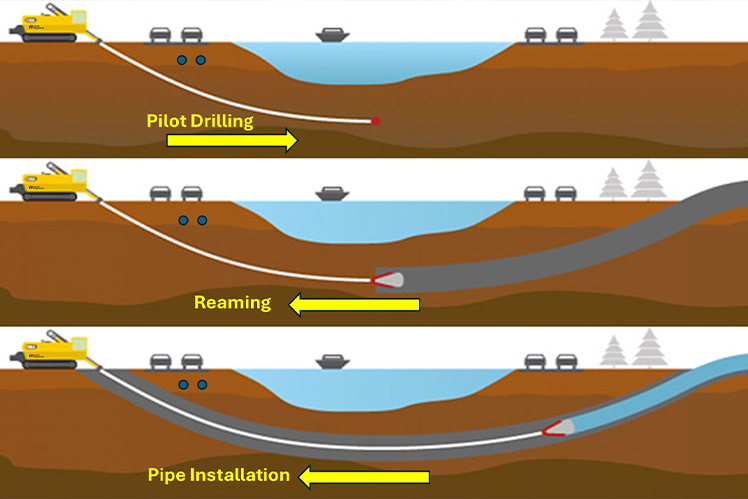
Suggested practice:
You can take bigger steps (like 50–100mm) in soft soil.
In hard rock or complicated formations, make the step size smaller (20–50mm) and move slowly.
Keep in mind that reaming is a delicate process that takes longer than it should.
Drilling Fluid Mixture: It’s Not Just for Lubrication
Drilling fluid does more than just keep the drill bit cool; it also stabilizes the borehole and carries cuttings.
Clay formations: To stop swelling and cut removal, add inhibitors.
Sandy or loose layers: Make the viscosity and wall-building properties stronger to stop collapse.
Rock formations: To make tools last longer, make sure they get enough lubrication and cooling.
To sum up, a bad mix of drilling fluids causes a lot of problems.
Always use drill pipes after the reamer, especially when drilling in rock!
This is the most important part of reaming operations that people forget about.
When reaming, the reamer must be directly connected to the drill pipes, not loosely connected with pipes or cables. Why?
If the drill pipes get stuck, break, or get buried, the problem can be quickly fixed by turning or pulling them back.
If you pull the pipe through rock formations to ream it, too much vibration can easily break the tool or cause the borehole to collapse, which makes it very hard to fix accidents.
If you don’t do this, the whole project could stop.
Trenchless reaming is a technical process that requires a lot of attention to detail to work. Every step, from figuring out the diameter and choosing the right tools to step-by-step reaming, mixing the drilling fluid, and putting the tools together, needs to be done carefully. We hope these five tips help you finish your projects faster and more safely!
You can leave comments if you have real-world experience or questions.
In construction, every little thing matters. If you follow the rules, you’ll be successful.
SHARE:
More Posts for You
- Choosing the right drill pipe supplier for your Vermeer D16x20
- HDD Drill Rod Bend Radius Calculator: How to Calculate Safety Limits
- Traceability of HDD Drill Rods: The Case for Heat Lots and Serial Numbers
- API 5DP vs API 7-1: Which Standard Actually Controls Drill Rods for HDD?
- Welding or Repairing a Cracked HDD Drill Rod? The Hard No and Safer Alternatives
- Why Mixing Different HDD Drill Rod Brands on the Same String is a Bad Idea
- HDD Drill Rods for Hard Rock vs Soft Ground One Size Does NOT Fit All
- Best Drill Rods for Large-Diameter Pipe Installation (24″ to 60″ Reaming Passes)