The Right Connection: A Quick Guide to Choosing Your HDD Pilot Assembly
In the precise world of Horizontal Directional Drilling (HDD), every component matters. The success of your pilot bore, the critical first step in any HDD operation, often hinges on a seemingly simple choice: how you connect your drilling assembly.
Choosing the correct pilot assembly configuration is not just a matter of convenience; it’s about efficiency, cost-effectiveness, and project success. To make an informed decision, it’s essential to understand the two primary connection methods. Let’s break them down.
The Two Pilot Assembly Configurations
Based on your equipment and project needs, you will typically choose between a Direct Connection or an OCT Connection.
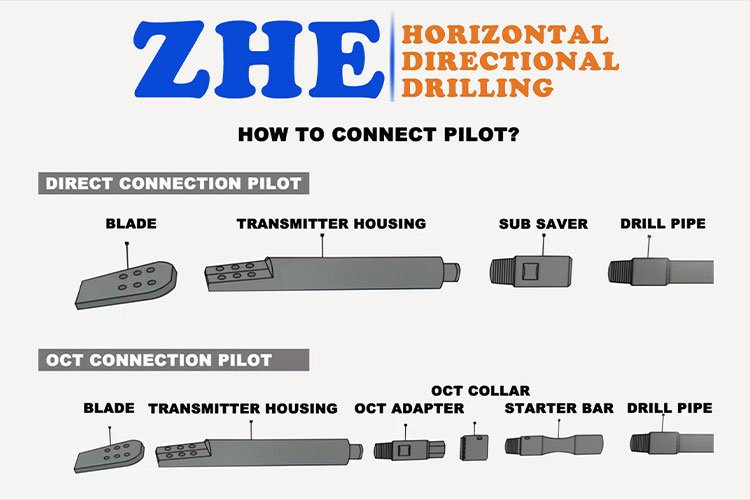
1. The Direct Connection Pilot
This configuration is a straightforward and robust assembly, ideal for standard drilling conditions. Its simplicity is its strength, minimizing potential failure points.
2. The OCT Connection Pilot
The OCT (One-Click Connection) system offers a faster, more tool-free assembly process. This method is excellent for operations that prioritize speed and ease of connection, especially when using starter bars.
- Assembly Sequence: Blade -> Transmitter Housing -> OCT Adapter -> Starter Bar -> Drill Pipe
Breaking Down the Components
- Blade: The cutting head that excavates the soil.
- Transmitter Housing: The compartment that holds the sonde (or transmitter), which relays crucial location and pitch data to the locator on the surface.
- Sub Saver: A protective component that threads onto the transmitter housing, designed to absorb wear and tear and prevent damage to the more expensive housing threads.
- Drill Pipe: The string of pipes that transmits torque and thrust from the drilling rig to the cutting head.
- OCT Adapter: The key component that allows for a quick, tool-free connection to the starter bar.
- Starter Bar: A short section of drill pipe used to initiate the bore from the rig, often used with OCT systems for a seamless start.
How to Choose: Direct vs. OCT
Your choice ultimately depends on your equipment and specific project requirements.
| Feature | Direct Connection | OCT Connection |
|---|---|---|
| Primary Advantage | Simplicity, durability, and fewer connection points. | Speed, ease of use, and tool-free assembly. |
| Ideal For | Standard drilling operations, crews using traditional threading methods. | Operations requiring fast setup/teardown, rigs equipped with OCT systems. |
| Key Differentiator | Uses a Sub Saver to protect the transmitter housing. | Uses an OCT Adapter and Starter Bar for a quick connection. |
Conclusion: There is No One-Size-Fits-All Answer
Both the Direct Connection and OCT Connection have their rightful place on the job site. The “right” pilot assembly is the one that best matches your rig’s capabilities and your project’s demands.
Before you start your next bore, take a moment to confirm your connection method. This small step ensures a smoother operation, protects your valuable equipment, and sets the stage for a successful and accurate pilot hole.
Remember: A successful HDD project starts with the right connection.
SHARE:
More Posts for You
- Why Your HDD Rod Threads Keep Rusting (And What I Learned from an Angry Old Man)
- The Day I Had a Warehouse Epiphany About HDD Drill Rods
- Where to do Horizontal Directional Drilling (HDD) Shines Actually

- The Moment I Realized Most People Buy HDD Drill Pipes All Wrong
- So You’re Buying HDD Drill Pipe? Let’s Talk About the Stuff That Actually Matters
- Maximize Your Ditch Witch Performance with ZHE HDD Drill Pipes
- How ZHE HDD Drill Pipes Make Your Ditch Witch JT100 Work Better and Better
- ZHE HDD Drill Pipes Will Help Your JT2720 Work Better