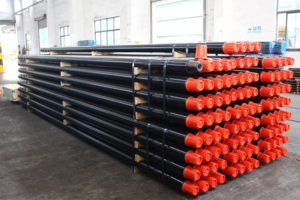
Drilling Through Broken Rock? Why Heavy-Wall HDD Drill Rods Are Needed
Let me tell you something that I learned the hard way.
I’ve been selling HDD drill rods for about 5 years now. And I remember walking into our factory warehouse the first week, looking at all those steel pipes stacked up and thinking to myself, “They’re just pipes, right? The long and the short. So what’s the big deal?
Yeah. I was pretty stupid.
Fast forward past a bunch of muddy job sites and a few snapped rods (thankfully not mine, but a couple close calls) and about a thousand conversations with guys who actually run these rigs day in and day out. I’ve learned that selecting the right drill rod is not as simple as picking up a wrench off the shelf. It’s more like choosing the right boots for a hike. You can wear sneakers on a rocky path. Sure. But by mile three you will hate life.
So, let’s discuss why fractured rock is a whole different beast, and why heavy-wall rods may very well save your sanity.
What Really Happens When You Hit Fractured Rock
This is the thing about fractured rock that nobody tells you.
It’s not like drilling through solid granite, where you just grind your way through nice and steady. Broken rock is tricky. You’ve got all these cracks, fissures and loose chunks of rock moving around down there. One minute you’re making progress, the next minute your rod is binding up because a piece of rock got wedged between the rod and the borehole wall.
And what about the mud situation? A bloody nightmare. Somehow, drilling fluid comes out through those fractures. You pump it down and instead of coming back up with your cuttings it just goes down into the rock like water into a sponge. Next thing you know you’ve lost circulation, you’re burning through bentonite like crazy and your borehole is collapsing because there’s no pressure to keep it open.
I had a customer once, let’s call him Dave, who was drilling through some nasty cobble and shale. He called me up, pissed as hell, because his rods kept stress fracturing after maybe 200 feet. He had bought “the good stuff” from a competitor. Good heat numbers. Well packaged. But Dave did not check the thickness of the wall for that particular ground condition.
He was on a rock playground using a rod for soft clay. It’s like bringing a butter knife to a steak dinner
The Standard Rod Question
Standard duty rods are your regular workhorse. Shallow bores, soft ground, shorter pulls — 300 to 500 feet, maybe 6 to 8 inches diameter. They are cheaper, lighter and easier on your thruster
But I have a personal rule, if you can smell gravel or broken rock, put these back on the rack.
“I’ve seen too many guys running standard rods in hard ground, trying to save a dollar, and then they’re crying when the rod breaks off at 400 feet. The problem is that standard rods just don’t have the guts to take the punishment. Broken rock hammers a drillstring to death. The constant impact, the vibration, the uneven loading. It all adds up. And the most common cause of drill rod failure is fatigue. It can happen at stress levels you wouldn’t believe.
Why Heavy Wall Rods Are Such a Game Changer
What is the difference? Let’s dive in.
So take a standard 100×120 HDD rod with a normal wall thickness of about 0.368 inches. Now compare that to a heavy wall rod at 0.449″ That extra 0.08 inches of steel doesn’t seem like much but it’s a big deal.
The heavy-wall string is approximately 18% stronger than the normal wall string in push and pull. That extra wall thickness is what keeps your string straight instead of turning into a pretzel as you push through broken rock and the rod starts to buckle under compression.
The trade-off: They are heavier. A complete string of heavy-wall rods weighs approximately 3,200 pounds more than a conventional string. You have to work harder to merely turn your rig.
But the thing is, that extra weight is peace of mind when you are 800 feet in and you hear that crunching sound through the ground. Trust me on this one.
The “Aha!” Instant
Remember Dave? We replaced him with a set of our heavy wall rod. Same setup. Same operator. Same mud mix.
He finished that bore and the rods were barely touched.
That was my epiphany. Not because our rods were magic, but because we finally fit the tool to the puzzle. That’s the secret they don’t tell you in the brochure.

A few things no one tells you about
Look, I’m not gonna sit here and say our rods don’t break. They’re steel, not magick. But, here’s what I’ve learned from pulling broken rods out of the mud at 2AM.
First thing is mark your rods. 1. Number each and every one of them. If rod #17 goes through ten bores without a hitch and rod #32 keeps giving you problems, you know which one to retire.
Second, check them like your life depends on it. Run your hand on each one of them. Feel a notch up? A trench? That rod is telling you it is tired. Hear it.
And for the love of all that is holy, torque to spec. Not what the dude next to you is doing. Not what “looked about right.” Use the fucking torque wrench. I’ve seen so many broken rods that would have been just fine if someone had just followed the numbers.
The Bottom Line
My two cents:
If you’re drilling in fractured rock and you’re still running standard wall rods, you’re playing roulette. And in the end, the house always wins. You could get lucky on a short bore. But the deeper you go, the more you hit rock, and the more those cracks start working against you. Sooner or later you’ll be fishing a broken string out of a hole, and that’s not a fun day for anybody.
Heavy-wall rods cost more up front. I can’t pretend otherwise. But then you look at the downtime, the lost productivity, the cost of the fishing operations, and the sheer frustration of dealing with snapped rods at 2 AM, and they pay for themselves pretty damn quick.
I’ve been doing this long enough to know that the guys who call me the least are the ones who treat their drill string like the precision instrument it is. They checked their rods. They do not over torque. They fit the tool to the ground.
And yeah, a lot of them run heavy-walled rods in fractured rock.
SHARE:
More Posts for You
- Traceability of HDD Drill Rods: The Case for Heat Lots and Serial Numbers
- API 5DP vs API 7-1: Which Standard Actually Controls Drill Rods for HDD?
- Welding or Repairing a Cracked HDD Drill Rod? The Hard No and Safer Alternatives
- Why Mixing Different HDD Drill Rod Brands on the Same String is a Bad Idea
- HDD Drill Rods for Hard Rock vs Soft Ground One Size Does NOT Fit All
- Best Drill Rods for Large-Diameter Pipe Installation (24″ to 60″ Reaming Passes)
- Friction Welding VS Inertia Welding on HDD Drill Rods What’s the Difference?
- Box vs. Pin End: Which Side of the HDD Drill Rod Fails First?