HDD Drill Rods for River Crossings: High Strength Options for Complex Bore Projects
Let me tell you something funny. I’ve been in the industry five years now and I still remember the first time a customer called me in a panic because his drill pipe broke halfway through a river crossing. He wasn’t looking for a sales pitch, he was asking me, “What the hell just happened?” And really? That moment changed my whole outlook on drill rods.
That was supposed to be easy. A crossing of a river, maybe 500 metres, nothing crazy. But the geology under that river was a nightmare – cobbles, hard strata, the lot. They were using grade rods, the kind that are good for 90% of jobs. But the 90% is not river crossings. They are the 10% that will eat your lunch if you’re not careful.
Why crossing rivers is a whole different animal
So here’s the thing with drilling under a river. You are not just dealing with dirt. You’ve got water pressure, you’ve got unpredictable geology, you’ve got the fact that if something goes wrong you can’t just go dig it up and fix it. You are dedicated. Once that pilot hole starts to bend under the river, there’s no turning back.
I’ve seen crews try to save money on drill rods for river jobs. “It’s boring,” they say. “Where is the difference? And then they’re spending three weeks fishing a broken string out of a hole with the client breathing down their necks. “I’d rather eat my hard hat than do another river crossing with the wrong rods,” one guy told me. That sticks with me.
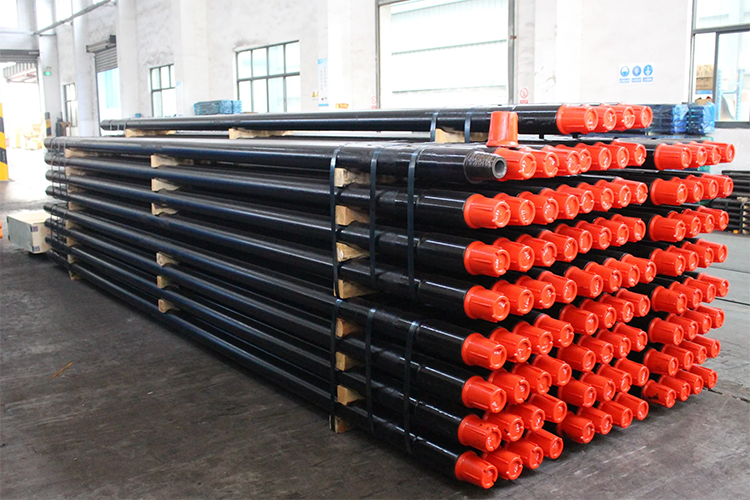
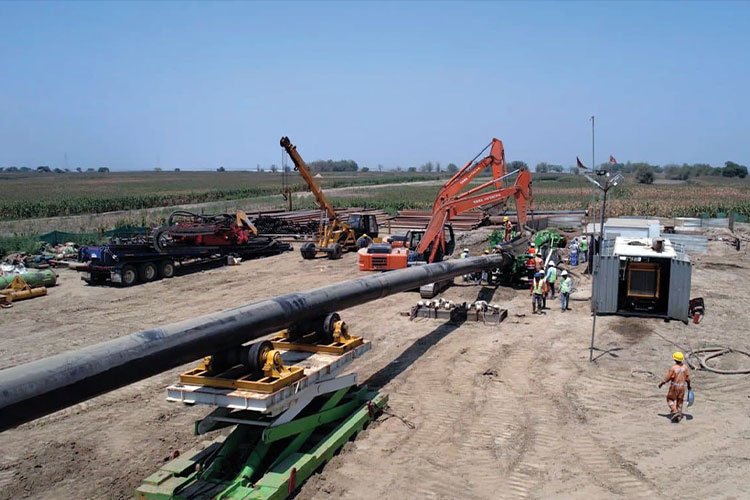
The Jiangyin Yangtze River project is a good example – they drilled 3,300 metres, which is nuts for HDD. They didn’t do it with off-the-shelf rods. They used a special high-strength Ø193.7 mm S-135 drill pipe at the pilot hole stage – one that’s not even in the standard API specs. Then they changed to Ø168.3 mm V-150 pipe for reaming because the torque was so brutal. They had to custom engineer solutions for each stage. That’s what river crossings are after.
The Fatigue Monster No One Talks About
Let me be honest with you for a moment. The silent killer of HDD projects is drill pipe fatigue. Statistics show that about 80% of drill pipe accidents while performing HDD are caused by fatigue, mainly manifested as fracture of the joint thread and welding line. And here’s the kicker – fatigue can be caused at stress levels well below the rated stress of the rod.
Think of the drill rod in a river crossing. It is bent, twisted, vibrated, pulled and pushed in all directions. Every time that rod goes around a curve it’s flexing. It’s getting a beating every time you reverse rotation. Those little stresses add up over hundreds of metres and thousands of rotations.
I remember a project on the Weihe River, which is a major pipeline for the Second West-East Gas Pipeline. The drill pipe just fractured on the sixth ream operation. Just like that. The investigation came back fatigue failure. They calculated the alternating stress at the point where the pipe connected to the reamer. And sure enough, it was a time bomb waiting to go off. The whole thing went wrong.
What High Strength Really Means
Okay, so you are convinced you need better rods. But what does “high-strength” mean in this context?
You will hear the two big names S-135 and V-150. S-135 is the workhorse — this is what most people think of when they say “high-strength” and directional drilling. But the V-150 is a step up. It is alloyed with other elements like molybdenum, nickel and vanadium. greater strength, better performance in extreme conditions.
The thing is – and I want to be straight with you about this – V-150 isn’t always the answer. Yes, it’s stronger. But I have seen data that shows V-150 can actually have a higher uniform corrosion rate than S-135 and that corrosion pits appear earlier on the sample surface. So if you have a lot of water or corrosive soils you have to consider that trade off.
There are grades like G-105 and even Z140 and U165 out there too. It’s not like one grade is the ‘best.’ The thing is that you have to match the rod to the job.
My Personal “Oh Shit” Moment
One call I got, I’ll never forget. It was from a contractor in the middle of a job. He was fishing with S-135 rods on a river crossing and they kept jamming. Not broken, just jammed. The torque was gone and the rods were twisting like spaghetti. He was about to give up the whole bore.
I asked him what his strategy was for reaming. They were using the same rods for all, pilot, reaming, pullback, he said. And that was the problem.
For the Jiangyin project, S-135 was used for the pilot hole, then V-150 for reaming. Why? Why? Reaming puts a lot more torsional stress on the rods. You’re turning bigger and bigger tools and the torque just keeps going up. You can’t use the same rods for everything and expect to have magic.’
We finally got some better quality rods for the reaming operation, and then the torque was down. It went through like butter. He phoned me back and said, ‘I should have listened to you three weeks ago.’ I said, “You ain’t the first, and you ain’t the last.
What I REALLY Say to Customers
If you are thinking about a river crossing – any river crossing – here is what I would tell you if you were sitting in my office:
First, don’t assume your standard drill rods will cut it. ** River crossings are the exception rather than the rule. The geology is unpredictable, the stakes are high and the cost of failure is enormous.
Secondly, consider the different stages of the job. Pilot hole, reaming, pullback, they all stress the rods in different ways. You might want different rods for different phases. I know it sounds like I’m trying to sell you more rod, but believe me, it’s cheaper than pulling a bad bore and starting over.
Third, watch out for fatigue. If you are reaming for days on end those rods are taking a beating. Rotate your stock, check it often and don’t over-rev the rods just because you’re in a hurry.
And finally, talk to somebody who really knows their business. Not just a sales guy reading a spec sheet, but someone who has been out in the field and knows what works and what doesn’t.
The Bottom Line
I sell drill rods for a living, look. But I would rather you bought the right rods once than the wrong rods twice. River crossings are stressful enough without equipment failure being added to the mix.
You have high strength options such as S-135, V-150 and others. But the thing is, it’s not just about buying the strongest rod on the shelf. It’s knowing what your particular job requires and then picking the rod that will meet those requirements.”
I’ve been doing this for five years and I learn something new on every project. That’s what makes it interesting. But if there is one thing I am sure of, it is this: don’t skimp on drill rods for river crossings. Your future self – and your client – will be grateful.
Questions? Hit me up. I’d like to shoot the shit. But don’t get me started on that Weihe River project unless you’ve got a couple of hours.
SHARE:
More Posts for You
- Traceability of HDD Drill Rods: The Case for Heat Lots and Serial Numbers
- API 5DP vs API 7-1: Which Standard Actually Controls Drill Rods for HDD?
- Welding or Repairing a Cracked HDD Drill Rod? The Hard No and Safer Alternatives
- Why Mixing Different HDD Drill Rod Brands on the Same String is a Bad Idea
- HDD Drill Rods for Hard Rock vs Soft Ground One Size Does NOT Fit All
- Best Drill Rods for Large-Diameter Pipe Installation (24″ to 60″ Reaming Passes)
- Friction Welding VS Inertia Welding on HDD Drill Rods What’s the Difference?
- Box vs. Pin End: Which Side of the HDD Drill Rod Fails First?