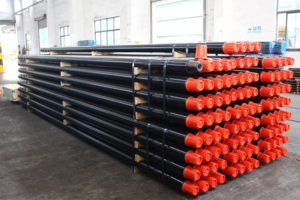
How I Learned to Quit Guessing and (Mostly) Read an HDD Rod Sizing Chart
You know that feeling when you are staring at a spec sheet and your eyes start to glaze over? You have the OD, the wall thickness, the thread type and three different part numbers that all look the same. And somewhere in the back of your head, you’re thinking, “Just give me the one that won’t snap in half.
I know that feeling. Really.
Five years ago I sat on the other side of this desk. I was the guy on the crew that had to make the 7 AM Monday call—with a muddy tracker, a pissed off foreman and a stack of pipe that didn’t quite fit the subs we had on site. I once ordered the wrong wall thickness. Only once. That was the day I learned that “close enough” doesn’t exist in HDD. We were 200 feet deep and the rod started to wobble like a wet noodle. That’s not a drill, that’s a stress test.
So, let’s look at the HDD Drill Rod Sizing Chart like we’re standing around the truck, drinking crappy coffee, trying to figure out why your last bid went to shit. I am not giving you a textbook. I’m going to provide you with the stuff I wish someone had yelled at me five years ago.
OD (Outer Diameter): It’s Not the Size, It’s the Squeeze
Everybody looks at the OD first. It’s the height of a basketball player. That’s the cool stat. But here’s the dirty little secret: The OD mostly just tells you what your rig can actually spin and what size hole you’re about to make.
If you are using a 2-3/8” rod you are not for a 12” bore. You’ll turn it into pretzels. That is a hard lesson. I remember a guy, let’s call him “Dave” who tried to go with a smaller OD because it was cheaper. He put $200 into the pipe and $4,000 into a fishing job. So OD is not a recommendation. That’s your limit for both torque and reamer size.
The golden rule I live by? The OD should match your rigs torque curve, not your budget. If your machine maxes out at 8,000 ft-lbs you don’t need that giant 4” OD. It will never give you the speed. You’ll be lugging that engine all day long, using twice the fuel. Your fuel bill will tell you the truth before I ever do, believe me.
Wall Thickness: The Rod’s “Belly”
Now, here’s where it gets personal. Wall thickness is the unsung hero or the quiet killer. It’s like a cheap aluminium can and a steel thermos. They look the same on the outside but the one on the inside is a whole different breed.
I used to think “thicker always equals stronger”. I was mistaken. The wall is thicker and the pipe heavier. More resistance and more weight on your thrust bearings and heavier pipe. You know what you get when you kick too much heavy pipe? You end up stuck. Not because the pipe breaks but because the borehole friction becomes a brake pad.
Here is my “Aha” moment. I was running a 3-1/2″ OD with a .300″ wall on a 500 foot shot in sandy clay. It was just right. Creamy smooth. Same site, same depth, next week we hit shale. That.300″ wall was starting to chatter. I could feel it shake in the cab. I changed to a .375″ wall. That extra 75-thou of an inch gave me the stiffness to chew through the rock without losing my steering. But I wouldn’t have put that thick wall in clay. That would have been a lot and slow.
So what is the one rule I live by? Wall thickness is not about strength, it’s about rigidity for the ground you’re on. A soft ground? Go light and thin. firm ground? Buff up. But don’t just buy the thickest one because you are scared. That’s like wearing a winter coat in July.” You’re just going to sweat and feel crappy.
Thread Types: The Handshake that Works (or Ruins Your Day)
Okay, this is the part where guys just want to pull their hair out. Box and pin, dual start, single start, tapered, flush – an alphabet soup of engineering.
Here’s the skinny. The threads are the most abused part of the rod. They are taking the initial hit, they are taking the torque, they are taking the wear and tear of making and breaking joints. If the thread doesn’t fit your tooling, you’re not just risking cross-threading. You run the risk of a wash out.
I had a buddy who bought a batch of used rods that had a “simular” thread to his drive sub. “It fits just about,” he said. That’s a dangerous thing to say. He got it finger tight but under load that little mismatch opened a gap. The thread face began to wash away in the mud. We call this “thread galling”. When he made the pullback the pin looked like a chewed up pencil eraser. We had to cut that rod off.
Here’s my advice: Stick to the industry norms. If you’re running API run API. Don’t mix it if you’re running a proprietary double start thread. I know guys that try to save money with adapters. Adapters are fine but they are a crutch. Every connection is a point of failure.
Me, myself? I’m a sucker for double-start threads. Why? Because they are made and broken fast. 10 seconds saved per joint on a 1,000-foot shot adds up to a lot of saved time at the end of the day,” he said. Time is money and the sun doesn’t wait for you to schedule.
“Combination” Vodou
This is the part that is often forgotten. These figures cannot be looked at in isolation. The OD, wall and thread all work together. If you have a big OD with a thin wall you have a flexible pipe. That’s great for steering, but terrible for transmitting torque. If you have a small OD with a thick wall you have a stiff heavy pipe but you lose fluid flow because the ID gets choked off.
“I always tell my guys. Draw the picture in your head.” Imagine the mud flowing inside. Imagine the torque twisting outside. Imagine the middle squeezing ground. That graph? It’s a map. The ground is the real ground. You wouldn’t take a tractor to a race track. You wouldn’t take a sports car off-road.
My Cheat Sheet for Life
This is how I break it down for my regular customers . If you are standing in the yard right now scratching your head .
For small rigs (Below 10k torque) 2-3/8” OD with .250” to .275” wall remain. Single start threads are OK. You are not moving mountains, you are moving pipes and cables. Keep it simple.
For mid range (10k-25k torque): This is the sweet spot. 3-1/2” OD is your bread and butter. For general dirt I’d go with a .300″ wall, .375″ if you know you’re going to hit cobble or limestone. And use double start threads please. There will be less spinning for you to do, and your back will thank you.
For the big boys (Over 25k torque): You’re in the 4″ + range. You know your stuff at this point. But this I’ll say: watch your ID. When you go to a thick wall here, you lose the fluid volume. The chart will give you the OD but I will guarantee you the driller is more interested in the flow rate.
Bottom Line (And a Little Whining)
Look. I can’t tell you which pipe to buy over a blog post. Even on the same street, the ground conditions are different. What I can tell you is the size chart is not there to confuse you. It begins the conversation. Look at the chart, if you don’t know call someone. Call me up. I’d rather you call me at 9 AM with a question than you call me at 5 PM asking where I keep the fishing tools.
Don’t let the numbers win. They’re only numbers. Real success is in dirt. And if all else fails, just remember: if it looks wrong, it is. Make it not happen. That’s when you hear the snap and nobody likes to hear that sound.”
What’s your favourite spec for rough terrain? Text or comment me. I love hearing about the weird combos you guys are running out there.
SHARE:
More Posts for You
- Traceability of HDD Drill Rods: The Case for Heat Lots and Serial Numbers
- API 5DP vs API 7-1: Which Standard Actually Controls Drill Rods for HDD?
- Welding or Repairing a Cracked HDD Drill Rod? The Hard No and Safer Alternatives
- Why Mixing Different HDD Drill Rod Brands on the Same String is a Bad Idea
- HDD Drill Rods for Hard Rock vs Soft Ground One Size Does NOT Fit All
- Best Drill Rods for Large-Diameter Pipe Installation (24″ to 60″ Reaming Passes)
- Friction Welding VS Inertia Welding on HDD Drill Rods What’s the Difference?
- Box vs. Pin End: Which Side of the HDD Drill Rod Fails First?