The HDD Mud Recycling System: An Unsung Hero for Efficiency and Environmental Safety
In modern Horizontal Directional Drilling (HDD) operations, drilling fluid, or “mud,” is rightly called the lifeblood of the project. It serves multiple critical functions: cooling the drill bit, stabilizing the borehole, carrying cuttings to the surface, and lubricating the drill string. However, managing the returned “waste mud,” which is laden with excavated solids, has always been a significant challenge.
The Mud Recycling System emerges as the core technical solution to this problem, acting as the “kidneys” of the operation and a vital tool for achieving green, efficient, and economical construction.
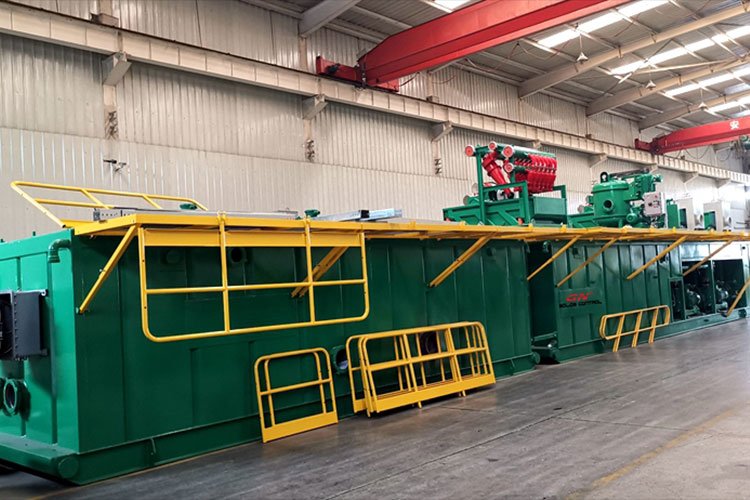
What is a Mud Recycling System?
A Mud Recycling System, also known as a Mud Cleaning or Purification System, is a set of modular equipment that integrates technologies such as vibrating screening, hydrocyclonic separation, and centrifugation. Its primary function is to purify the drilling fluid returned from the borehole in real-time. It separates and discharges solid drill cuttings while recovering clean, specification-compliant mud for immediate reuse.
Key Components and Workflow
A typical Mud Recycling System consists of several core components connected in series, forming an efficient purification pipeline:
1. Shale Shaker
- Role: The “first line of defense” and the most critical primary treatment stage.
- Working Principle: Returned dirty mud is fed onto a high-frequency vibrating screen panel. Liquid and fine particles pass through the screen mesh into a collecting tank below, while larger cuttings (typically >74 microns) are separated and discharged to a waste collection area.
- Importance: It removes over 80% of solids, significantly reducing the load on subsequent stages.
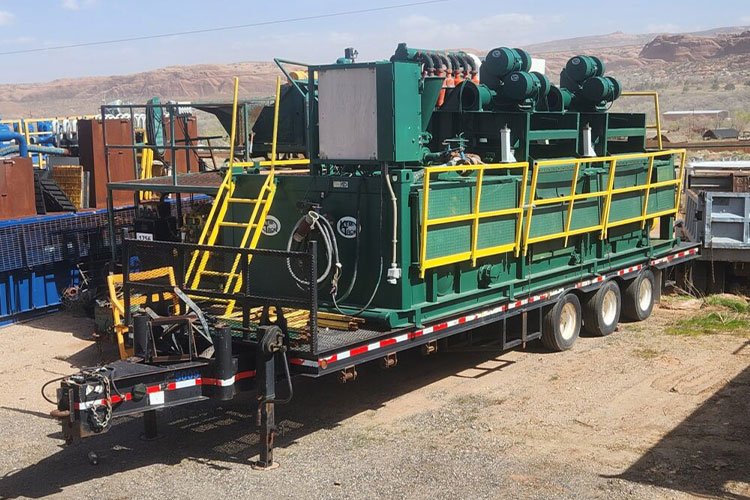
2. Desander and Desilter
- Role: The system’s “fine filters.”
- Working Principle: Operating on the principle of hydrocyclonic separation, the pre-screened mud is pumped tangentially into a set of cone-shaped hydrocyclones.
- Desander: Typically separates medium-sized particles ranging from 45 to 74 microns.
- Desilter: Targets and removes fine particles between 15 and 45 microns.
- Inside the hydrocyclone, centrifugal force pushes heavier solids to the walls and down to the bottom discharge (underflow), while cleaned mud exits through the top outlet (overflow).
3. Decanter Centrifuge
- Role: The “ultimate purifier” for ultra-fine particles and colloids.
- Working Principle: It uses a high-speed rotating bowl to generate centrifugal forces thousands of times greater than gravity. This allows it to separate particles as fine as 2-5 microns, which is crucial for controlling mud viscosity and density, especially in complex geology or high-specification projects.
4. Auxiliary Systems
- Mud Tanks & Agitation System: For storage, mixing, and circulation of mud, equipped with agitators to prevent settling.
- Mud Pumps: Provide the necessary pressure to circulate mud throughout the entire system.
- Piping and Valves: Connect all components to form a complete closed-loop circuit.
Simplified Workflow:Dirty Mud from Borehole → Shale Shaker (removes large solids) → Desander (removes medium solids) → Desilter (removes fine solids) → Centrifuge (removes ultra-fines) → Clean Mud Returns to Tank → Re-pumped into Borehole for Reuse
Core Benefits of Using a Mud Recycling System
Implementing a Mud Recycling System delivers comprehensive and significant benefits to any HDD project:
1. Significant Economic Benefits
- Reduces Material Costs: Recycles 80-90% of drilling fluid and additives, directly cutting down on expensive material purchases.
- Lowers Disposal Costs: The separated cuttings have low water content and reduced volume, drastically cutting transportation and waste disposal fees—often the most immediate cost saving.
- Improves Operational Efficiency: A continuous supply of high-quality mud prevents drilling issues like stuck pipe or borehole collapse, ensuring project timelines are met.
2. Outstanding Environmental Benefits
- Minimizes Environmental Footprint: Dramatically reduces the volume of waste mud, lowering the risk of contaminating soil and water sources.
- Facilitates Regulatory Compliance: Drier cuttings are easier to handle, transport, and dispose of in accordance with stringent environmental regulations.
- Promotes Resource Circulation: Aligns with circular economy principles by turning “waste” into a reusable resource.
3. Critical Engineering Benefits
- Ensures Borehole Stability: Clean mud maintains optimal viscosity and filter cake properties, effectively supporting the borehole wall and preventing collapse.
- Optimizes Drilling Performance: Clean fluid ensures better cuttings transport and lubrication, reducing tool wear and power consumption, thereby increasing the rate of penetration (ROP) and success.
- Enhances Site Safety: Systematically reduces engineering risks associated with poor mud performance.
Application Scenarios and Selection Guide
Mud Recycling Systems are not one-size-fits-all; selection depends on specific project parameters:
- Small, Short-Distance Projects: A high-efficiency Shale Shaker alone may suffice.
- Medium to Large Projects: A standard configuration of “Shale Shaker + Desander + Desilter” is essential.
- Complex Geology (e.g., through clay, bentonite) or Long-Range Crossings (e.g., rivers, estuaries): A Decanter Centrifuge is mandatory to control colloidal content and ensure project success.
Key Selection Parameters: Bore diameter and length, geological conditions, mud type (polymer or bentonite-based), environmental requirements, and project budget.
Conclusion
As trenchless technology advances and environmental regulations tighten, the Mud Recycling System has evolved from an optional accessory to an indispensable standard for successful HDD projects. It is more than just machinery; it embodies an advanced philosophy of precision engineering, cost control, and environmental stewardship. For any HDD contractor striving for excellence, efficiency, and responsibility, investing in a well-matched Mud Recycling System is akin to powering their operations with a high-performance, green engine.
SHARE:
More Posts for You
- Choosing the right drill pipe supplier for your Vermeer D16x20
- HDD Drill Rod Bend Radius Calculator: How to Calculate Safety Limits
- Traceability of HDD Drill Rods: The Case for Heat Lots and Serial Numbers
- API 5DP vs API 7-1: Which Standard Actually Controls Drill Rods for HDD?
- Welding or Repairing a Cracked HDD Drill Rod? The Hard No and Safer Alternatives
- Why Mixing Different HDD Drill Rod Brands on the Same String is a Bad Idea
- HDD Drill Rods for Hard Rock vs Soft Ground One Size Does NOT Fit All
- Best Drill Rods for Large-Diameter Pipe Installation (24″ to 60″ Reaming Passes)