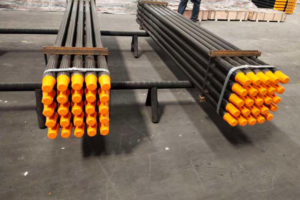
HDD Drill Rod Fatigue Life: How Many Bends Can Your Pipe Actually Take?
Look, I’m going to be honest with you. When I first got into this business about five years ago, I thot fatigue life was some fancy term that the engineers used to sound smart. I thought, ‘It’s steel pipe. It’s hard. How many bends can it really take before it surrenders?”
Yeah. I was a fool.
I want to tell you about the day the illusion was broken—and why I now lose sleep over something as dull-sounding as “bend cycles.”
The day I knew we were all just guessing
It was Tuesday afternoon, one of those muggy, hot days when your hardhat feels like a hair dryer strapped to your head. I was on-site with a customer we’ll call Mike. Good guy, been running HDD rigs for fifteen years, doesn’t suffer fools. He’d just hit a 60-foot shot under a four-lane highway, everything went textbook, and then he handed me a piece of drill rod that looked like the ugly cousin of a twisted pretzel.
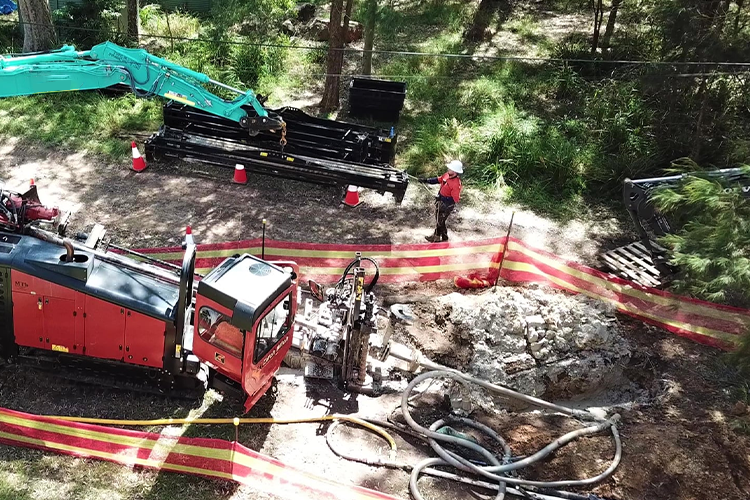
“Rod number three this month,” he said, not even angry, just tired. “Same place. Same radius of bend. “What is all this about?”
I gave him the usual sales pitch about the grade of material and heat treatment and all that, and he just looked at me. Not crazy. Just… depressed. As if I had served him a salad when he had ordered a steak.
That’s when it hit me, I didn’t really know how many bends that pipe could take. I knew the numbers on the spec sheet. I knew the tensile strength “But I couldn’t look him in the eye and say, ‘Mike, under these conditions you’ve got about 1,200 good bends before you’re playing Russian roulette.’
That was the warning. That nite I went back to the shop. I started rummaging thru test data like a maniac.
The One Job That Continues to Haunt Me
One year on. A crew working a river crossing, 1,200 feet of sandy clay, nothing wild. We’d laid a full string of 4.5-inch rods. But, the entry angle was tighter than the client admitted to on the bid (shocker, right?). They were twisting those rods around like they were trying to fold a fitted sheet.
By the third day they’d broken two rods in mid-pull. It cost them a day of downtime, a fishing job that lasted six hours and a lot of colorful language directed at my phone.
I arrived and ripped the data logger off their rig. Their bend radius was hovering around 85 feet – well below the minimum 100-foot we suggest. They’d already put just about 2000 bend cycles on that pipe in the last two months.
The thing that no one tells you about fatigue life is that it’s not a light switch. It’s not a sudden break down. First it murmurs. Micro cracks . A little wobble to the joint. A slight loss of torque. But if you don’t listen you’ll miss it – until that whisper becomes a scream and your drill string is in two pieces 80 feet down.
The Math That Keeps Me Straight
Okay, time for the nerdy stuff, but I promise to make this painless.
Every time your rod bends, it gets something called a “reversal of stress.” It’s like bending a paper clip back and forth. The first few times it’s okay. Then it warms up. It becomes brittle. Then snap.
Steel does the same thing, only slower and at more expensive consequences.
The industry rule of thumb? Most reputable manufacturers will design for anywhere between 500,000 and 1,000,000 fully reversed bend cycles in a controlled lab environment. That seems like a lot, doesn’t it?
But this is where reality bites you in the face: lab tests are a perfect, uniform bend radius. No inclusions of rocky. Operator error? Nope. No ‘let’s just push it a little harder because the sun’s going down’.
In real life, your fatigue life can be reduced by 50% or more depending on:
Ground conditions (rock vs sand is day and nite)
Bend radius (tighter=shorter life, no way around it)
Fluid quality (bad lubrication = more friction = more heat = more fatigue)
Operator habits (I’ve seen guys who treat the joystick like a volume knob, and guys who treat it like an on/off switch—guess which one breaks more rods?)
So if you were to ask me, “How many bends can your pipe take? my honest answer is: “It depends – but let me show you how to make sure it’s as many as possible.”
The One Question That Nobody Asks (But Should)
Here’s a weird thing I’ve noticed over the years: customers always inquire about new rod performance. Tensile, yield, hardness, all the sexy numbers.
But nobody asks about after the first 500 times.
And that’s where the real story lies. Because a rod that is great on day one and falls apart at 800 bends is no good to you. You want a rod that gracefully fades, not a dramatic meltdown at mile 10.
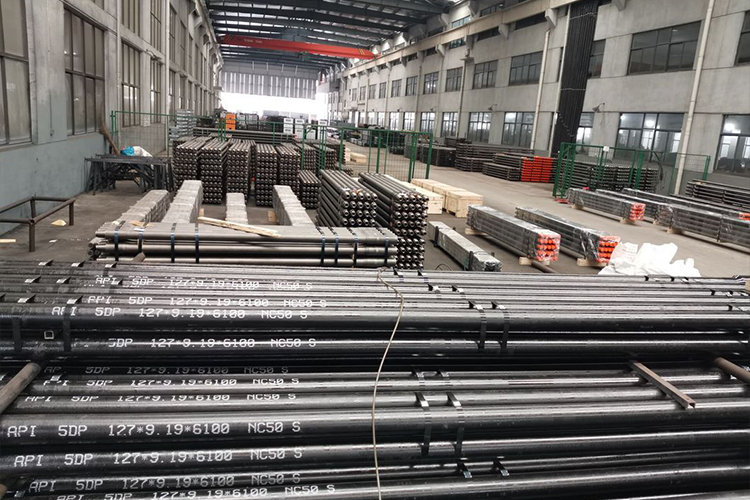
That’s why I’ve started asking my factory guys to do extended fatigue tests on every new batch we make. No, not the “pass/fail” stuff. The actual cycle counts. At 500 bends, what is the hardness holding up at? “You got any micro-cracking starting at the tool joint at 1,000? Are we still safe at 1,500 or are we playing roulette?
And I’ll be honest with you, there are some batches that surprise me. A slightly different heat treat process can add 200 bends to the life. A little tweak to the thread compound? Another hundred cycles. It’s wild how the little things build up.
So, Can You Give Me a Number?
Good . If you held a gun to my head and asked me for a rule of thumb, this is it:
In good conditions (moderate sand/clay, 100-foot bend radius, decent fluid, competent operator), a quality 4.5-inch rod is probably safe for 800 to 1,200 significant bend cycles before you should seriously consider retiring that pipe from critical pulls.
But don’t put that in the bank. I’ve seen rods last 1,800 cycles in clean ground, and I’ve seen rods snap at 400 in rocky, high-heat conditions with an operator who believes “feathering” is something you do to a chicken.
All I can say is this: follow your curves. Not every little wiggle, but the big ones. The ones that are approaching your minimum radius.” Go ahead. Keep a book of log. When you reach that 1,000 cycle mark, begin inspecting your pipe like a hawk. Search for galling. Check for step wear Listen for that dull thud when you torque up. That’s your rod telling you it’s had enough.
My Frank, Slightly Blunt Advice
If you’re on a big job, especially a river crossing or a bore under something valuable like a runway, don’t try to get the last 100 bends out of an old string. I know, I know, new steel is costly. But you know what costs more? 2am fishing job in the rain and the project manager ringing you every ten minutes for an update.
Been there. Done that. Got it done. Got the T-shirt with mud on it.
What I tell my regulars is, rotate your string. Save your freshest rods for the hardest sections (entry and exit curves, tight radii) and the older, more fatigued rods for the straight stretches in between. It’s not rocket science—it’s just smart wear and tear.
And what if you have any doubts? Ring me. For realz. “I’d rather you woke me up at 6 AM with a question than at 11 PM with a broken rod and a crane on the way.
The Bottom Line (If There Is One)
Fatigue life is not a single number. It’s a conversation between you, your ground conditions, your operator and your pipe.” My job isn’t to sell you a “indestructible” rod (there is no such thing, and if someone tells you there is, they’re selling magic beans). I sell you a rod that’s predictable. You know when it’s time to change, when it’s time to push, and when it’s time to pull the plug.
So next time you’re on site and feel that rod bend thru the bend, give yourself a little mental high five. It’s doing its job. Don’t expect it to look the same when you ask it to do that job a thousand times.
This is hard business we’re in. Your schedule and your budget don’t matter to the ground. But a little knowledge on fatigue life? That’s one thing that really will save your butt.
And if you’ve got a war story about a rod that just wouldn’t quit (or one that quit way too soon), I want to hear it. I’ll buy you coffee next time I’m around your way. We can trade fibs and bend radius stories.
SHARE:
More Posts for You
- Choosing the right drill pipe supplier for your Vermeer D16x20
- HDD Drill Rod Bend Radius Calculator: How to Calculate Safety Limits
- Traceability of HDD Drill Rods: The Case for Heat Lots and Serial Numbers
- API 5DP vs API 7-1: Which Standard Actually Controls Drill Rods for HDD?
- Welding or Repairing a Cracked HDD Drill Rod? The Hard No and Safer Alternatives
- Why Mixing Different HDD Drill Rod Brands on the Same String is a Bad Idea
- HDD Drill Rods for Hard Rock vs Soft Ground One Size Does NOT Fit All
- Best Drill Rods for Large-Diameter Pipe Installation (24″ to 60″ Reaming Passes)