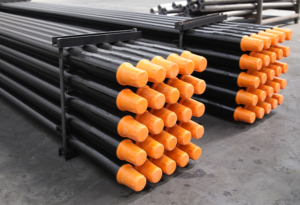
Okay, let’s talk about something that doesn’t get enough attention: the inside diameter of your HDD drill rod.
Everybody talks about O.D. Outside diameter this, wall thickness that, tensile strength, torque, thread style. All of them are important. But if you’ve ever stood next to a mud pump that sounds like it’s going to file a complaint with HR then you know the inside of the rod matters too.
I’ve been around HDD drill rod for about five years. And I’ve had this conversation more times than I can count. “Why is my pump pressure so high? “Why am I not getting enough flow to the bit?” “Why doesn’t the hole get filled? And sometimes the answer isn’t the pump, isn’t the bit, and – sorry to all the mud guys out there – isn’t always the mixing recipe. Sometimes it’s the drill rod diameter.
To be honest, I do work at a drill rod factory. So I have a dog in the hunt. But I promise, this isn’t a “buy bigger ID” pitch. It’s more of a “know what you are asking your rod string to do” kind of conversation.
What an ID really does
Your drilling fluid needs to go from the pump through the drill rod, through the tool joints and connections, down to the bit or reamer and back up the annulus. The ID of the drill rod is basically the highway for that fluid.
If the ID is too small for your flow rate you get more friction pressure loss. And not a little bit extra. Roughly speaking, pressure drop increases rapidly as ID decreases. So you get a lot of pump pressure. Little flow and a lot of heat and wear that you don’t want.

Here’s where people sometimes miss the boat: Drill rod ID does not directly dictate your annular velocity. Annular velocity is a function of hole size, rod OD, and flow rate. But the rod ID limits the amount of flow you can realistically push before your pump pressure goes bananas. And if you cannot pump enough flow, then hole cleaning suffers. Cuttings accumulate. You get stuck tools. High torque. Pack-off. Long day for everyone.
Also important is ID for cooling downhole tools and for staying within the flow window a mud motor needs if you’re running one. Too little flow can result in bad motor performance or overheating. If you tie yourself down too much, you might never get to the flow you really wanted.
A short story from the trenches
I recall a crew working on a hole cleaning problem. First they blamed the pumps. Then the bit Then the mud-mixing guy, sorry, Dave. Everything on paper looked “fine.” But when we looked at the actual flow path, the rod string had a smaller connection bore than they had thought. The pipe body was not the problem. In essence the connection was choking.
They bumped the pump, pressure spiked, and still they weren’t getting the flow they wanted at the bit. Once they changed out the rod/connection setup to fit the job and tweaked the mud programme, things calmed down. No magic. Just less restriction in the flow path.
That’s why I always tell customers, don’t just compare OD and wall thickness. Please confirm actual through bore and connection ID. The thread space can be the choke point.
Larger ID is not automatically “better”
Now, before you ask for the biggest ID on the planet: there is a trade off. A larger ID for the same OD means a thinner wall. This can affect the rod’s tensile strength, torsional strength, stiffness, wear life and how it behaves downhole. You’re sacrificing flow area for mechanical performance.”
So the goal isn’t “maximum ID.” The goal is the right ID for your pump, your flow rate, your hole size, your mud properties, your downhole tools, your pullback loads and your rod string design. The ideal rod for one project might be a poor choice for another.
What I’d check before you order
When specifying drill rod, or troubleshooting a flow problem, consider:
What is the real rod body ID?
What is connection ID 0. Is it less than the body?
What flow do you need at the bit or reamer?

What pump pressure can you tolerate?
Are you using a mud motor or other tool that requires a flow rate?
What is your hole size & rod OD , What are you shooting for for annular velocity?
Are you doing a lot of backreaming where hole cleaning is important?
When comparing rods, don’t just compare catalogue OD. Request the real flow-path numbers. Your pump will thank you for it. Your mud guy will enjoy it. Dave will be to thank for that.
So yeah, the inside diameter is what matters. It’s not the sexiest topic in HDD, but it’s the kind of quiet detail that decides if your fluid goes where it’s supposed to or if you spend the afternoon staring at pressure gauges and questioning your career choices.
If you’re not sure if your current rod ID matches your job, give me a shout. I love talking drill rod, mud flow and why the inside of the pipe deserves a little more respect.
SHARE:
More Posts for You
- Horizontal Directional Drilling Tools: How to Compare Drill Rod and Backreamer Quotes
- 6 Warning Signs Your HDD Drill Rod Is Failing (Before It Breaks Downhole)
- HDD Drill Pipe S135 1.32″ x #200 for Vermeer D6x6 Navigator

- HDD Drill Rod ID and Flow of Drilling Fluid: The Importance of Inside Diameter
- How to Budget for HDD Drill Rods: Plan Replacements Based on Wear Rates
- HDD Drill Rod and Reamer Matching: Preventing Vibration and Uneven Wear
- Developing a Smarter HDD Drill Rod Procurement Strategy: From Line Item to Performance Spec
- Which one lasts longer, one-piece forged drill rod or friction-welded drill rod?