Essential Tips to Know for HDD Drill Rod Upkeep and Maintenance
Let’s be honest for a second. In this non-stop trenchless world I’ve been in for about five years now, if there is one thing that still makes me cringe, it’s watching a $5,000 drill rod get turned into a twisted piece of scrap metal because someone got lazy. And I’m not blaming anyone — I’ve been that guy.
I remember my second year on the job, we were on this huge river crossing project, everything was going smooth and I decided to skip the morning lube check because, y’know, coffee was more important. Big error. By noon we had a stall that cost us three hours of rig time and a pretzel-like rod. My boss didn’t yell, he just gave me that look. You know the type. That look says, I’m not mad, I’m just disappointed. That hurt so much more.
So listen to a guy who’s learned the hard way, and caring for your HDD rods isn’t just “maintenance.” It saves your back, your wallet and your sanity. Here are the nuggets of wisdom I’ve picked up along the way. No textbook mumbo jumbo, just the stuff that really works.
The “Coffee Break” Clean-Up
You know how we all wipe our mouths after a greasy breakfast sandwich? Do the same with your rod threads. It doesn’t matter if you’re on a sandy job site in West Texas or sticky clay down in Florida. The enemy is filth. Full stop.
I have a habit now, I carry a wire brush in my back pocket and every time I break a joint I give the male and female threads a quick flick. Maybe it takes ten seconds. An old-timer once taught me a trick: he would spit on the thread and wipe it with his glove to see if there was any grit. Crude ? Yes. Effective? Definitely. If you get that grinding feeling while you’re packing the joint, stop. Back it down, clean it again and start over. The ‘gritty’ feeling basically means your rod is SCREAMING for help.
Don’t be Cheap Dope
I’m going to be a little passionate here. Thread, compound. Pipe dope. Whatever you call it, use it. And go nuts, I mean. I see guys out there using a drop the size of a pea and wonder why their threads are galling. It’s like making a pizza with one shred of cheese.” It simply doesn’t work.
I’m not saying you need to smother it like peanut butter on a sandwich, but you need total coverage. And hey,keep your dope clean! How many times have you seen that open bucket of dope on the ground collecting sand? If you take that, and dip your brush in it, you’re just rubbing sandpaper on your pins. Now I use a pump dispenser or a small squeeze bottle. It keeps the crap out and saves me tonnes of money in the long run. Also do not mix brands. When you start mixing different types of dope, you’re essentially making a chemical cocktail that could eat your rods from the inside out. Stay with one good kind.
That “Bad” Torque vs. “Good” Torque
This is where I get to sound like a broken record to my younger crew, but torque isn’t just a number on a screen. It is an art. You know how when you’re mixing a joint and it hits that “sweet spot”? This is what we are looking for. If you tighten it too much, because you think “tighter is better”, you will just stretch the metal. You’re wearing it out. It’s like bending a paperclip back and forth, eventually it’s just going to snap.
I learned this when I had to use a cheater bar on a pipe wrench because we didn’t have a proper torque gauge on site We over-torqued a 4-1/2″ rod to hell. It was so stuck we had to cut loose. That was a $2,000 mistake, and it taught me to respect the spec sheet. If you don’t have a torque monitor on your rig, buy a torque sub. It’s worth every cent.
Storage: Don’t Just Toss ’Em in a Pile
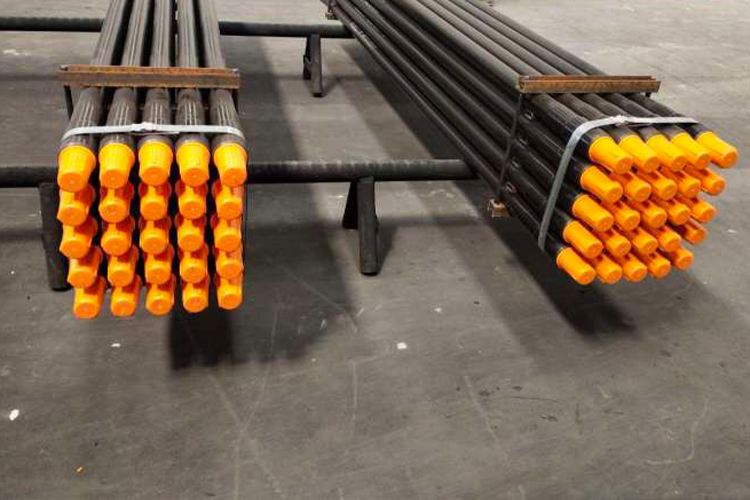
Alright this one annoys me the most. I have been on yards where the drill rods are just laying in the dirt like a stack of fire wood. It brings a tear to my eye. Think about it, your rods are high strength steel but they don’t like sitting in a puddle. Rust is the killer.
Rack your rods with the rods off the ground. Put them on some wood blocks, or some pipe racks. And if you are going to keep them for a while? Spray the OD and the threads with a bit of light weight oil. It’s like throwing a blanket over them. And don’t lay them flat for years and years. If possible, stand them up, or at any rate turn them round now and again. If you leave them sagging in the middle too long, they are not going to be perfectly straight the next time you need them. And a bent rod means a wobbly well bore. “Nobody wants that.”
Listen to the Machine:
This one sounds a little hippie-dippy, but hear me out: Your rig is speaking to you. You can feel and hear the difference between a happy rod and a stressed rod when you rotate. If the mud pump pressure surges or the torque starts to go up and down wildly, don’t just slam the throttle forward. Halt. Check your rods.
I was in Houston working on a pull back on 24″ product. The rig groaned and I kept bumping the torque. I put it down to ‘just tough ground’. Well, what I actually had was a cracked rod about two feet from being snapped in half. If I hadn’t checked, that rod would have broken, and we’d have lost that borehole. That feeling when you catch a problem early, man, it’s better than finding a $20 bill in your old jacket.
Get a “Targeted” Pair of Eyes
Maybe it’s the 5-year vet in me, but before you chuck a rod down the hole, take a quick peek at the pin. Touch it with your finger. Does it feel like a skateboard? Not? Good. Check for flat spots. Check for bruises.
The most common rookie mistake is to only check the male end (the pin). You gotta check the box too (the female end)! Shine a flashlight in there! I’ve found debris, rust flakes and once found a small o-ring that somehow got stuck in there. And imagine torquing that up and smashing it into the joint. It would have iced up in seconds.
Know When to Let Go
This is the tough part. We get attached to our things, don’t we? Loading a worn rod, however, is like playing Russian roulette. If you have had to cut and re-machine the threads too many times, or the rod is obviously bent (put it on a couple of stands and spin it and you’ll see the wobble), just retire it.
I have a little mark on my rod racks with a paint pen. If it makes it past a certain amount of wear, I use it for “short-start” sections, or as a lead-in rod where wear doesn’t matter as much. But when it’s toast, I turn it into a fence post or a yard ornament. It’s cheaper to buy a new rod than to pay for downtime when one breaks down in the middle of a highway crossing.
Ok, I will get off my soapbox now. But see, I sell these things. I know the costs. I see the guarantees. And I see the guys who take 15 minutes at the end of the day to clean their rods and lube the threads. They’re the ones who clock out on time. They are the ones who get paid. Be that dude.
Stay safe out there, don’t forget your earplugs and for Christ’s sake check your thrust bearings.
SHARE:
More Posts for You
- Choosing the right drill pipe supplier for your Vermeer D16x20
- HDD Drill Rod Bend Radius Calculator: How to Calculate Safety Limits
- Traceability of HDD Drill Rods: The Case for Heat Lots and Serial Numbers
- API 5DP vs API 7-1: Which Standard Actually Controls Drill Rods for HDD?
- Welding or Repairing a Cracked HDD Drill Rod? The Hard No and Safer Alternatives
- Why Mixing Different HDD Drill Rod Brands on the Same String is a Bad Idea
- HDD Drill Rods for Hard Rock vs Soft Ground One Size Does NOT Fit All
- Best Drill Rods for Large-Diameter Pipe Installation (24″ to 60″ Reaming Passes)