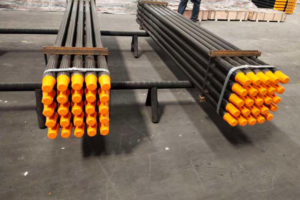
Drilling Through Fractured Rock? Why You Need Heavy-Wall HDD Drill Rods
Get me a coffee and I will tell you a story. I’ve been working on drill pipe for about five years now, out of our little factory, and if there’s one thing that still makes me wince, it’s the sound of a pipe twisting off 200 feet down. It’s that nasty crack that runs up the string and suddenly your torque goes loose, your mud pressure drops, and your heart sinks.
In my early days I remember my first big “rock job”. I I was just a junior sales guy, but I thot I knew it all because I had read the spec sheets. I sold a standard wall rod to a contractor who was drilling through what the geotech report called “competent limestone.”
Yeah, sure. Capable.
That limestone was more broken than my phone screen. We got in about 40 feet and began to have trouble. The rods were flexing so badly in the voids they looked like a wet noodle coming out of the bore. We kept pushing and pop-twist up.
We fished it out, but the job was held up two days. The contractor wasn’t mad, but he gave me that “I told you so” look and I felt two inches tall. That was my light bulb moment. It wasn’t about selling more expensive pipe, it was about selling the right pipe so I never had to see that defeated look on a guy’s face again.
The “Slinky” Effect (And Why It’s Your Worst Enemy)
Here’s the thing that no one tells you about fractured rock in horizontal directional drilling. This isn’t like crashing into a solid wall. It’s all about hitting pockets.
You’re spinning along, hitting solid stuff, and then WHAM, your bit drops into a void. That 40-foot length of rod behind the bit is suddenly unsupported laterally. Just hanging there in mid air (or mid rock I guess) spinning at high RPM.
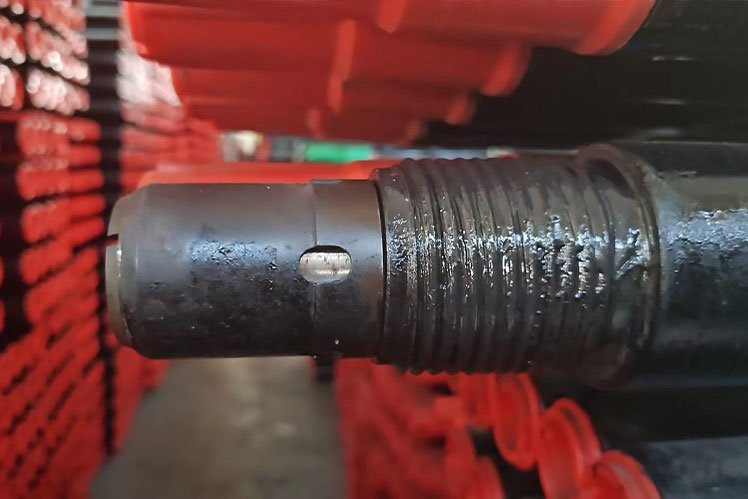
What happens with a standard-wall rod? It lashes. It spins in that emptiness like a jump rope. That whipping puts a crazy amount of stress on the tool joint threads. It’s not the weight of the pull that kills them, it’s the oscillation. It’s galling. Every time that rod whips, it is slowly eating at the metal on the connection.
For that reason I use heavy-wall rods for these jobs. It’s not about being stronger (though they are), it’s about mass. They are more rigid. They don’t whip as easy. They go into that void and say “Nope I’m too heavy to dance around in here. They keep the string stable . So your threads are happy .
The “Unseen” Cost of Saving a Buck
I hear you. We’re all trying to keep the bid down. I’m a sales guy and I hate callbacks.
When I see the contractor trying to run normal rods through smashed granite or basalt, I always ask him, “What’s your rig downtime worth?
Because here’s the ugly math:
When you break a rod, you don’t just buy a new rod. You are buying a fishing job. You are paying for the time to pull the string, ream the hole and maybe abandon a bore if you can’t get it back.
I had a customer named Mike who was a stubborn old goat. He refused to buy heavy wall for he said the “weight was too much for his thrust”. Good call. But he kept breaking the pins. After the third break he finally went to our heavy wall.
A week later he called me and he didn’t even say hi. He just yelled down the phone, “Why didn’t you make me buy these sooner?!”
He didn’t alter his thrust settings. His RPM didn’t alter. He only changed the pipe. The vibration was absorbed by the extra wall thickness. The difference ? He stopped breaking bars. Instead of three shifts, he finished the job in one.
The “Feel” Test (Don’t Dismiss It)
Here’s a tip from the field, not the brochure.
Listen to your machine when you’re pushing into that fractured zone. If it is chattering, that horrible jitter-jitter sound, your rods are sending too much shock back to the carriage.
Heavy wall rods act like a shock absorber. That extra steel mass is killing the harmonics. Provides a smoother drilling feel. And when your operator isn’t white-knuckling the joystick, they’ll drill faster. They’re more powerful.
So Do You Really Need Them?
Look, I don’t come here to sell you pipes with a gold plate. You are boring in clay? Save your money. The standard stuff.
But if you glance through the drilling plan and see words like ‘fault lines’ or ‘gravel’ or ‘highly fractured’—don’t fuck around. You want the thick wall.
Look at it this way: Would you climb a mountain in a blizzard wearing a t-shirt? No. You put on the heavy coat. It’s not as forgiving, but it keeps you alive. The heavy jacket is heavy-wall tubing. They might be a little more expensive at first, and they might be a pain to haul around, but they’ll keep you out of the hole.
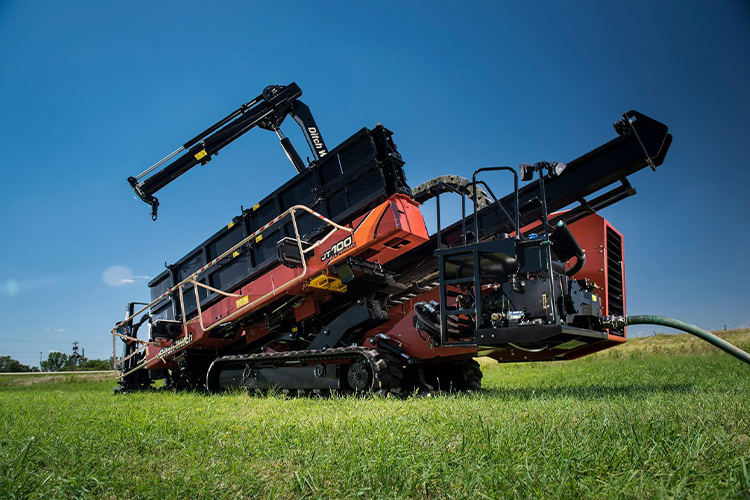
And believe me, after five years of seeing the stress on the jobsite, I’d rather you call me bragging about how you got record footage than calling me crying about a stuck reamer.
Have a gnarly rock gig lined up? Get in touch. We can check out the spec sheet and see if you need that extra steel. Just don’t wait until you are on site looking at a broken rod in your hands. “I’ve been there and it’s not fun.”
Stay alert, keep spinning and for the love of god, keep an eye on those torque readings.
SHARE:
More Posts for You
- Choosing the right drill pipe supplier for your Vermeer D16x20
- HDD Drill Rod Bend Radius Calculator: How to Calculate Safety Limits
- Traceability of HDD Drill Rods: The Case for Heat Lots and Serial Numbers
- API 5DP vs API 7-1: Which Standard Actually Controls Drill Rods for HDD?
- Welding or Repairing a Cracked HDD Drill Rod? The Hard No and Safer Alternatives
- Why Mixing Different HDD Drill Rod Brands on the Same String is a Bad Idea
- HDD Drill Rods for Hard Rock vs Soft Ground One Size Does NOT Fit All
- Best Drill Rods for Large-Diameter Pipe Installation (24″ to 60″ Reaming Passes)